Free to print, share in a club newsletter or post in a group. Please keep it as is, with the CQDeck name on it.
Read it as text
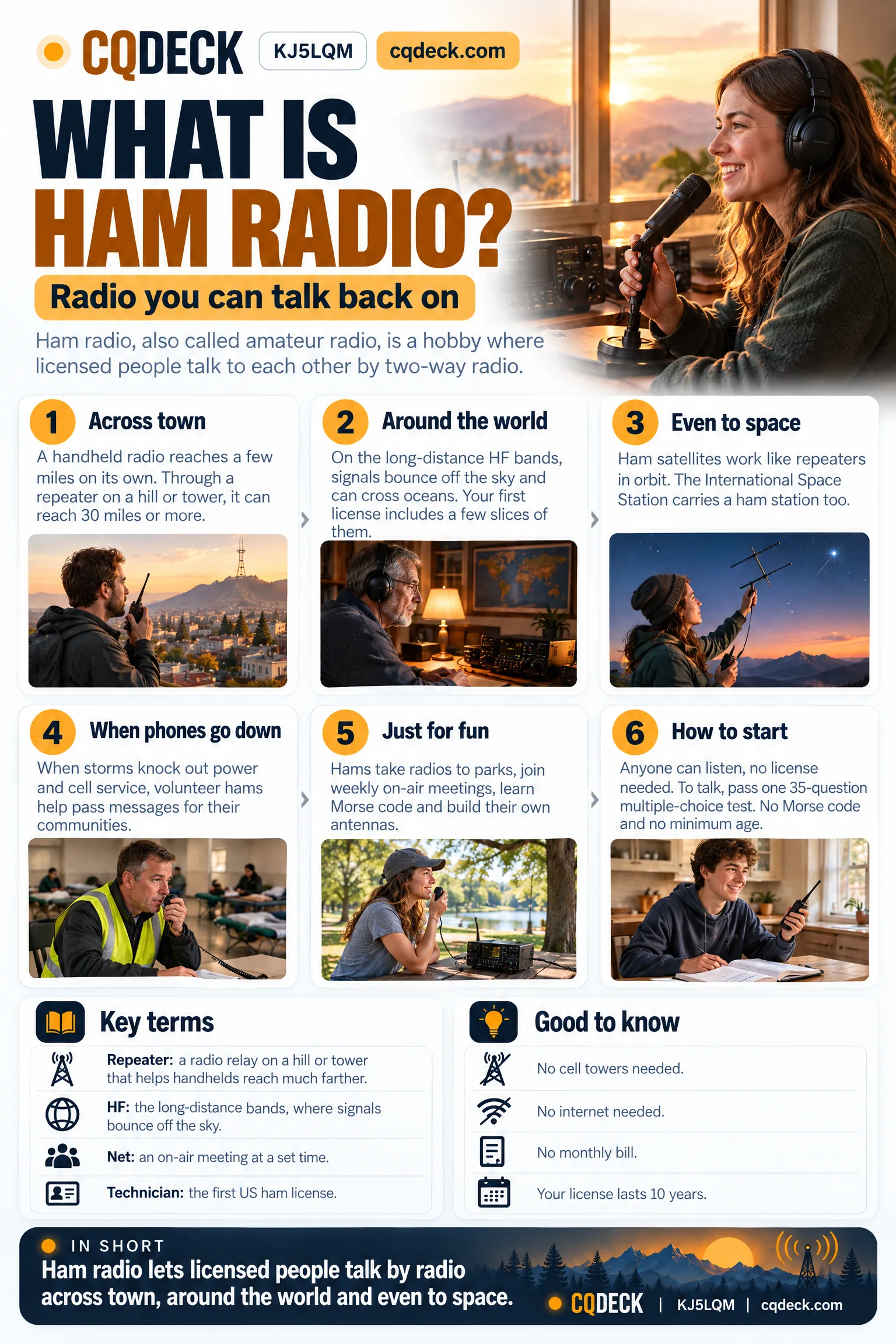
Radio you can talk back on. Ham radio, also called amateur radio, is a hobby where licensed people talk to each other by two-way radio.
- Across town. A handheld radio reaches a few miles on its own. Through a repeater on a hill or tower, it can reach 30 miles or more.
- Around the world. On the long-distance HF bands, signals bounce off the sky and can cross oceans. Your first license includes a few slices of them.
- Even to space. Ham satellites work like repeaters in orbit. The International Space Station carries a ham station too.
- When phones go down. When storms knock out power and cell service, volunteer hams help pass messages for their communities.
- Just for fun. Hams take radios to parks, join weekly on-air meetings, learn Morse code and build their own antennas.
- How to start. Anyone can listen, no license needed. To talk, pass one 35-question multiple-choice test. No Morse code and no minimum age.
Key terms
- Repeater: a radio relay on a hill or tower that helps handhelds reach much farther.
- HF: the long-distance bands, where signals bounce off the sky.
- Net: an on-air meeting at a set time.
- Technician: the first US ham license.
Good to know
- No cell towers needed.
- No internet needed.
- No monthly bill.
- Your license lasts 10 years.
In short: Ham radio lets licensed people talk by radio across town, around the world and even to space.
Checked October 2026 against FCC Part 97 and AMSAT.