Free to print, share in a club newsletter or post in a group. Please keep it as is, with the CQDeck name on it.
Read it as text
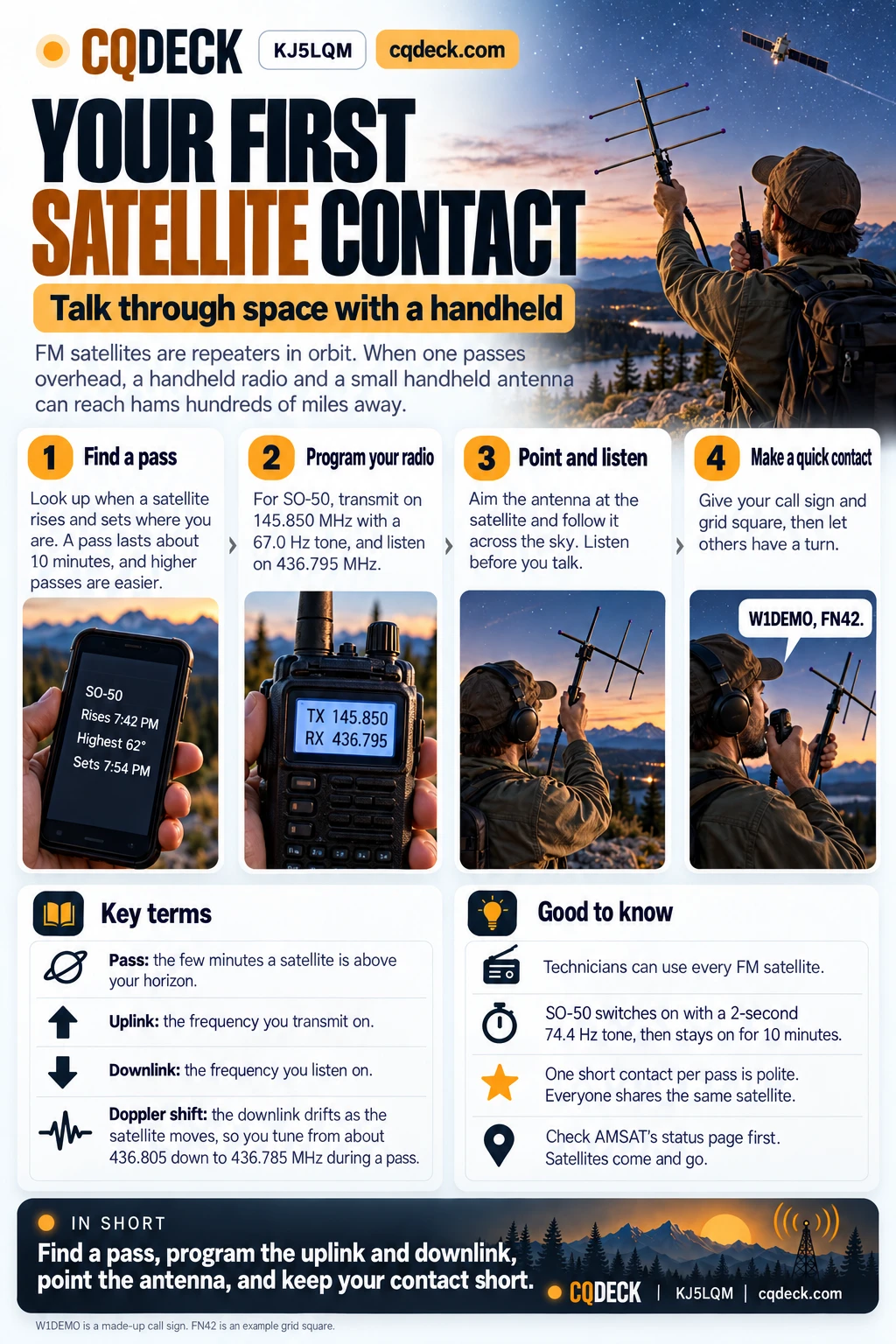
Talk through space with a handheld. FM satellites are repeaters in orbit. When one passes overhead, a handheld radio and a small handheld antenna can reach hams hundreds of miles away.
- Find a pass. Look up when a satellite rises and sets where you are. A pass lasts about 10 minutes, and higher passes are easier.
- Program your radio. For SO-50, transmit on 145.850 MHz with a 67.0 Hz tone, and listen on 436.795 MHz.
- Point and listen. Aim the antenna at the satellite and follow it across the sky. Listen before you talk.
- Make a quick contact. Give your call sign and grid square, then let others have a turn.
In the pictures
- A pass on a phone: SO-50, rises 7:42 PM, highest 62°, sets 7:54 PM.
- The radio: TX 145.850, RX 436.795.
- A contact: “W1DEMO, FN42.”
Key terms
- Pass: the few minutes a satellite is above your horizon.
- Uplink: the frequency you transmit on.
- Downlink: the frequency you listen on.
- Doppler shift: the downlink drifts as the satellite moves, so you tune from about 436.805 down to 436.785 MHz during a pass.
Good to know
- Technicians can use every FM satellite.
- SO-50 switches on with a 2-second 74.4 Hz tone, then stays on for 10 minutes.
- One short contact per pass is polite. Everyone shares the same satellite.
- Check AMSAT’s status page first. Satellites come and go.
In short: Find a pass, program the uplink and downlink, point the antenna, and keep your contact short.
W1DEMO is a made-up call sign. FN42 is an example grid square.
Checked October 2026 against AMSAT’s FM satellite list (July 2026) and FCC Part 97.