Starter guide
How to get your ham radio license
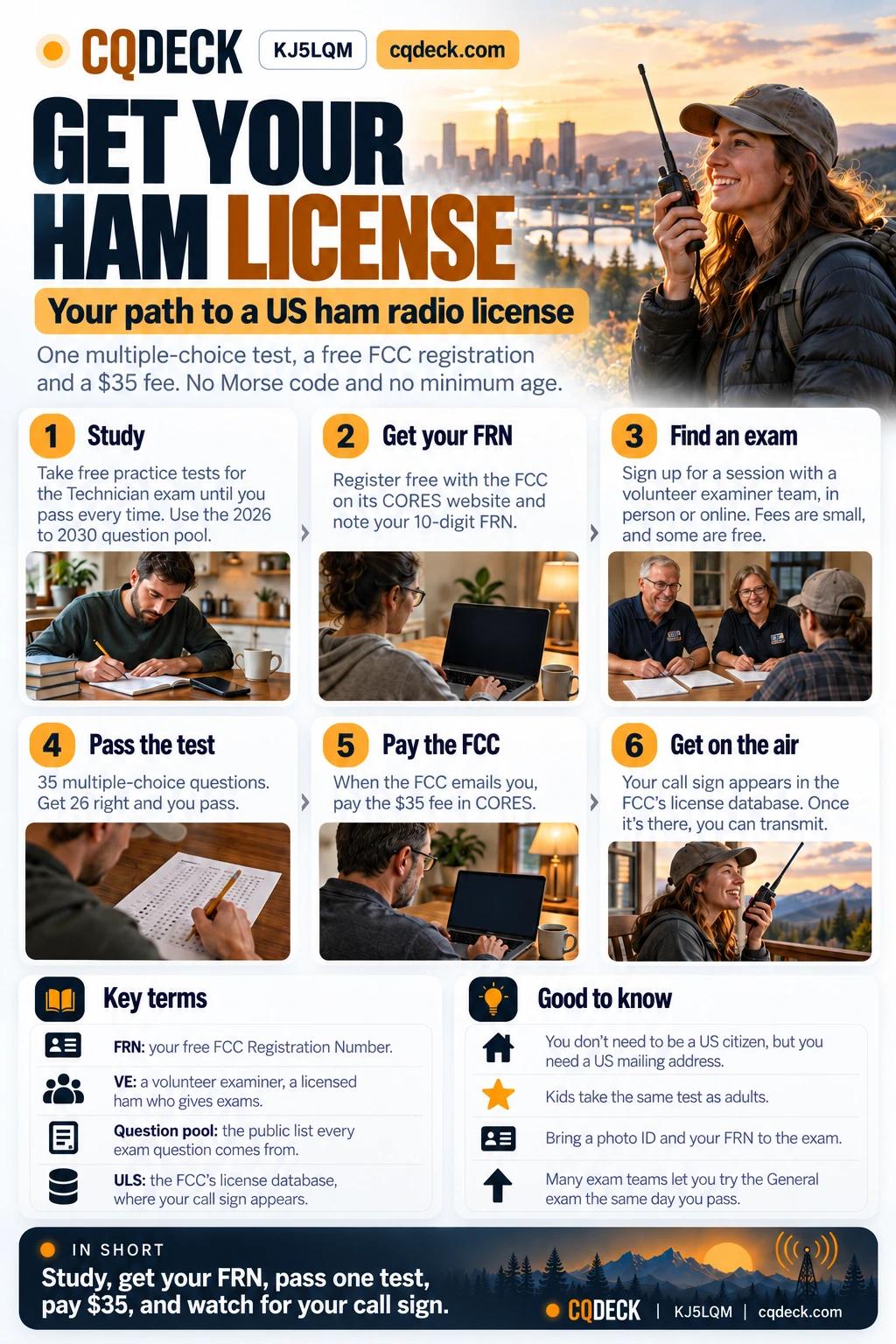
Getting your first ham license takes one multiple-choice test, a free FCC registration and a $35 fee. There’s no Morse code and no minimum age. Here’s every step, from your first practice test to your first call.
Printed from www.cqdeck.com/learn/get-your-license. The page always has the latest version.
The whole path
- Study for the Technician exam with free practice tests.
- Get a free from the FCC.
- Sign up for an exam session, in person or online.
- Pass the test: 26 or more right out of 35.
- Pay the FCC’s $35 fee when its email arrives.
- Watch for your , then get on the air.
Who can get a license
- Anyone except a representative of a foreign government. There’s no minimum age, and kids take the same test as adults.
- You don’t need to be a US citizen, but you need a US mailing address where the FCC can reach you, and an email address.
- Morse code isn’t part of any exam. You can learn it later if it interests you.
- Your license is yours alone. Family members who want to transmit need their own.
Which license to start with
There are three license classes, and each one adds more bands. Almost everyone starts with Technician, and you can upgrade any time later.
| Technician | General | Extra | |
|---|---|---|---|
| Exam | 35 questions, 26 to pass | 35 questions, 26 to pass | 50 questions, 37 to pass |
| Opens | Every ham band above 50 MHz, Morse on parts of HF, and voice on part of 10 meters | Most of the HF bands that reach across the country and around the world | Every amateur privilege |
| Needs | Nothing first | A Technician license or a pass that day | A General license or a pass that day |
- Technician covers local repeaters, simplex, satellites, Parks on the Air and more.
- If you’re ready, you can try the General exam at the same session after passing Technician. With ARRL exam teams, one fee covers one try at each exam.
How to study
Every exam question comes from a public question pool, so nothing on the test is a surprise. The Technician pool has about 400 questions, and each test draws 35 of them.
- A new Technician pool took effect July 1, 2026, and runs through June 30, 2030. Make sure your book, app or course covers the 2026 to 2030 pool; anything older studies the wrong questions.
- Free practice tests and flashcards, like HamStudy, explain each answer and show which topics you keep missing.
- Short daily sessions work better than cramming. A few weeks is common.
- Take full practice tests until you pass them comfortably every time, not just once.
- Memorizing answers will get you through the test, and that’s how many hams start. Understanding comes faster once you’re on the air, and our first 30 days guide fills in the practical gaps.
- Listen while you study. You don’t need a license to listen: a scanner or an online receiver lets you hear your local repeater and nets, and the rules on the test start to make sense.
Try itThe hardest exam topics, explainedFree study toolsListen onlineRehearse a contact on Key Up
Get your FRN first
Your FCC Registration Number is how the FCC files your exam results and your license. It’s free, and exam teams ask for it before the test.
- Go to the FCC’s CORES site and create a username with your email address.
- Log in and choose to register a new FRN, using your Social Security number.
- Write down the 10-digit FRN, or save the confirmation email. You’ll give it to your exam team.
Keep your CORES login. You’ll use it to pay the $35 fee and to download your license.
Try itFCC CORES
Find an exam session
Exams are given by teams of , licensed hams who volunteer under one of the national exam coordinators. Sessions happen almost every weekend, at clubs, libraries and fire stations, and online.
- Search sessions by date, place or online with HamStudy’s session finder or the ARRL’s.
- Register ahead when the listing asks you to. Some sessions take walk-ins, many don’t.
- Session fees are small: ARRL teams charge $15, or $5 if you’re under 18, and some teams, like Laurel VEC’s, charge nothing. That’s on top of the FCC’s $35.
- If you fail, you can test again. A retake usually means another session fee, and some teams let you retake the same day.
- Need an accommodation, like more time or a reader? Ask the team when you sign up.
What to bring
- A photo ID, like a driver’s license, passport or school ID. Without one, bring two other IDs; ask the team which ones count.
- Your FRN.
- The session fee, in the form the team asks for. Many in-person teams take cash or a check.
- Two pencils and a pen.
- A calculator if you want one, with its memory cleared. Phone calculators aren’t allowed.
- If you’re upgrading: a copy of your license and any CSCE from an earlier session.
Taking the test online
Many teams give the exam over a video call, so you can test from home.
- You need a computer with a camera, a microphone and steady internet. Most teams use Zoom.
- A phone or tablet as a second camera helps you show the room and your ID, though not every team requires one.
- Pick a quiet room where no one will interrupt you, and clear your desk of notes and study materials.
- At the start, the examiners check your ID on camera and have you show the room around you.
On test day
- The Technician test is 35 multiple-choice questions. Get 26 right and you pass.
- The examiners grade it on the spot, so you’ll know before you leave.
- If you pass, you get a certificate called a CSCE. Keep it: it counts as credit for the exam you passed for 365 days.
- The team sends your results to its coordinator, which files them with the FCC, usually within a few days.
Pay the FCC’s $35 fee
- Watch your inbox for an email from the FCC with a link to pay. Check your spam folder too.
- Log in to CORES with your FRN and pay the $35 within 10 calendar days.
- If you miss the 10 days, the FCC dismisses the application. You won’t need to retest; your exam team can refile it while your CSCE is still valid.
- After the payment goes through, a second email links to your official license.
Upgrading to General or Extra later doesn’t cost an FCC fee. Only a new license, a renewal and a vanity call sign do.
Your call sign
- The FCC assigns the next call sign in line, usually two letters, a number and three letters. The number comes from the region you lived in when it was issued, and you keep it if you move.
- You can transmit as soon as your call sign shows up in the FCC’s . Nothing comes in the mail: the database record is your license, and you can download a copy.
- Want a shorter call sign or one with meaning? You can apply for a vanity call sign later, for another $35.
- Your license lasts 10 years. Renewing it costs the same $35 FCC fee, and you can renew in the last 90 days before it expires.
Try itGet an email when your call sign is issuedA reminder before it expires
Once you’re licensed
- Program your radio for your local repeaters before your call sign arrives, so you’re ready the moment it does.
- Our first 30 days guide takes you from your first call to your first net, park contact and satellite.
- Nervous about your first call? Rehearse it on Key Up, where a practice station answers like a real one.
- Find a local club. Clubs teach classes, run exam sessions and have experienced hams happy to help.
Sources
- FCC rule 97.5: who can hold a license
- FCC rule 97.23: mailing address
- FCC rule 97.503: exam elements and passing scores
- FCC rule 97.505: credit for passed exams
- FCC rule 97.509: volunteer examiner sessions
- FCC rule 97.301: frequencies by license class
- ARRL: the 2026 to 2030 Technician question pool
- ARRL: the FCC’s $35 application fee
- ARRL VEC: what to bring to an exam session
- ARRL VEC 2026 exam fees
- Laurel VEC sessions on HamStudy
- GLAARG: remote exam FAQ for examinees
- ARRL: the FCC’s electronic licenses