Starter guide
How ham radio nets work and how to check in
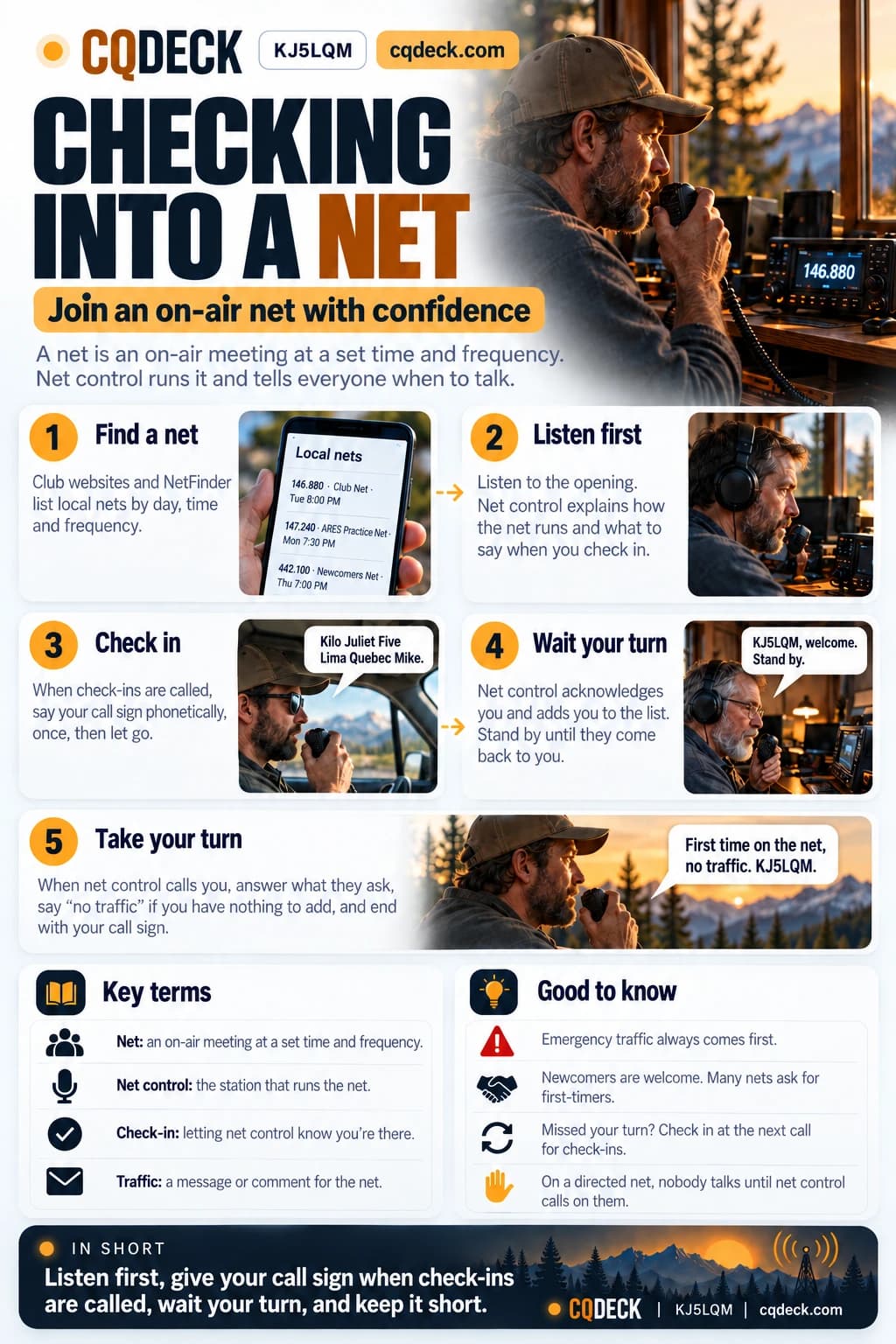
A is an on-air meeting at a set time and frequency. runs it and tells everyone when to talk, which makes a net the easiest place for a new ham to get on the air.
Printed from www.cqdeck.com/learn/how-nets-work. The page always has the latest version.
What a net is
- Nets meet on a schedule, like every Tuesday at 8 p.m. on a club’s repeater. Many meet weekly; some meet every night.
- Most nets are directed: nobody transmits unless net control calls on them. Some are informal, and people take turns more freely.
- There are club nets, social nets for chatting, emergency practice nets (ARES), weather nets (SKYWARN) that meet during storms, and traffic nets that pass written messages.
- Newcomers are always welcome. Many nets ask new hams to check in by name.
How a net runs
Most nets follow the same pattern, so after one or two you’ll know what’s coming.
- Net control opens with a preamble: the net’s name, what it’s for and how it runs.
- Net control asks for emergency or priority traffic first. Unless you have an emergency, stay quiet.
- Net control calls for check-ins. Some nets take everyone at once; others go by area, or by the last letters of call signs (“suffixes Alpha through Mike”).
- Net control reads back the call signs it heard, then goes down the list, giving each station a turn.
- Late check-ins are taken near the end.
- Net control closes the net and returns the repeater to regular use.
How to check in
- Listen to the preamble. It tells you what to give: your call sign alone, or your call sign, name and location.
- When check-ins are called, wait for a pause, then press the button and give your in : “November Zero Charlie Alpha Lima Lima.” Say it once, then let go.
- Wait for net control to acknowledge you. If you weren’t heard, try again at the next call for check-ins.
- When net control comes back to you, answer what they ask, then end with your call sign.
Phrases you’ll hear
- “No traffic”: you have nothing for the net. “With traffic” or “with a comment” means you do, and net control will come back to you.
- “Short time”: you can’t stay long, so net control will take you early.
- “For the log”: you’re checking in to be counted, with nothing to add.
- “Doubled”: two stations talked at once and neither got through. Net control may ask for “the station ending in Charlie” to go again.
- “Relay”: a station that can hear someone net control can’t passes the message along.
- “Checking out”: you need to leave before the net ends. Tell net control with your call sign, and they’ll release you.
An example check-in
A first check-in on a directed net.
- Net controlThis is W1DEMO, net control for the Tuesday Night Net. Is there any emergency or priority traffic? … Hearing none, we’ll take check-ins now. Please give your call sign phonetically.
- YouNovember Zero Charlie Alpha Lima Lima.
- Net controlI have N0CALL. N0CALL, go ahead with your name and location.
- YouThis is Sam in Riverton. First time on the net, no traffic. N0CALL.
- Net controlWelcome to the net, Sam, and congratulations. You’re coming through fine. Stand by for the next round.
Don’t worry about getting it perfect. Net control handles first-timers every week, and a missed turn is no problem.
Find a net
- Local club websites list their nets, and many clubs run one on their repeater every week.
- NetFinder lists nets by time and frequency.
- Listen to a whole session before your first check-in, so you know the routine.