Free to print, share in a club newsletter or post in a group. Please keep it as is, with the CQDeck name on it.
Read it as text
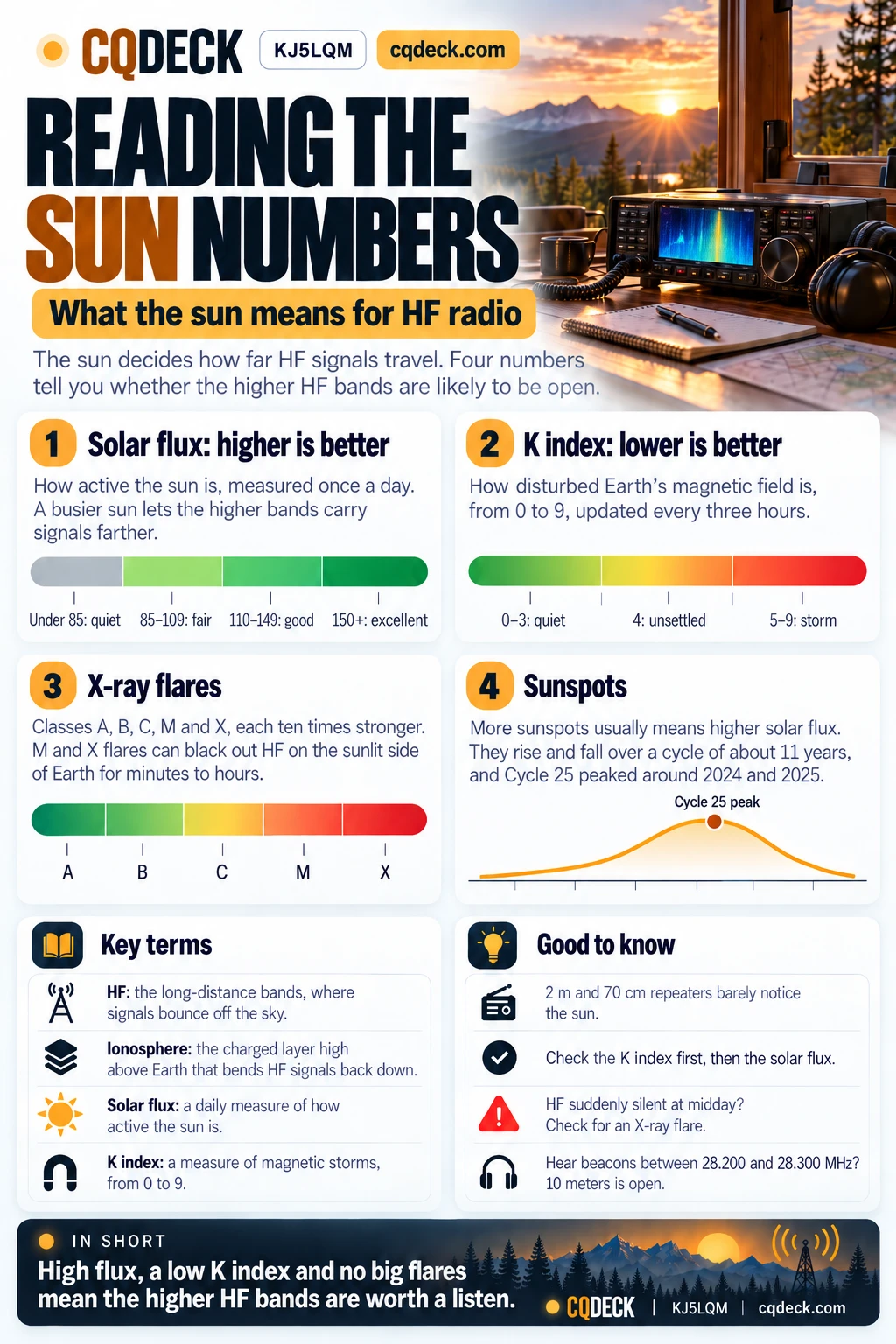
What the sun means for HF radio. The sun decides how far HF signals travel. Four numbers tell you whether the higher HF bands are likely to be open.
- Solar flux: higher is better. How active the sun is, measured once a day. A busier sun lets the higher bands carry signals farther.
- K index: lower is better. How disturbed Earth’s magnetic field is, from 0 to 9, updated every three hours.
- X-ray flares. Classes A, B, C, M and X, each ten times stronger. M and X flares can black out HF on the sunlit side of Earth for minutes to hours.
- Sunspots. More sunspots usually means higher solar flux. They rise and fall over a cycle of about 11 years, and Cycle 25 peaked around 2024 and 2025.
In the pictures
- Solar flux gauge: under 85, quiet; 85–109, fair; 110–149, good; 150 and up, excellent.
- K index gauge: 0–3, quiet; 4, unsettled; 5–9, storm.
- X-ray gauge, mildest to strongest: A, B, C, M, X.
- Sunspot curve: rising and falling, with Cycle 25’s peak marked.
Key terms
- HF: the long-distance bands, where signals bounce off the sky.
- Ionosphere: the charged layer high above Earth that bends HF signals back down.
- Solar flux: a daily measure of how active the sun is.
- K index: a measure of magnetic storms, from 0 to 9.
Good to know
- 2 m and 70 cm repeaters barely notice the sun.
- Check the K index first, then the solar flux.
- HF suddenly silent at midday? Check for an X-ray flare.
- Hear beacons between 28.200 and 28.300 MHz? 10 meters is open.
In short: High flux, a low K index and no big flares mean the higher HF bands are worth a listen.
Checked October 2026 against NOAA’s Space Weather Prediction Center.