Starter guide
How to read solar numbers for ham radio
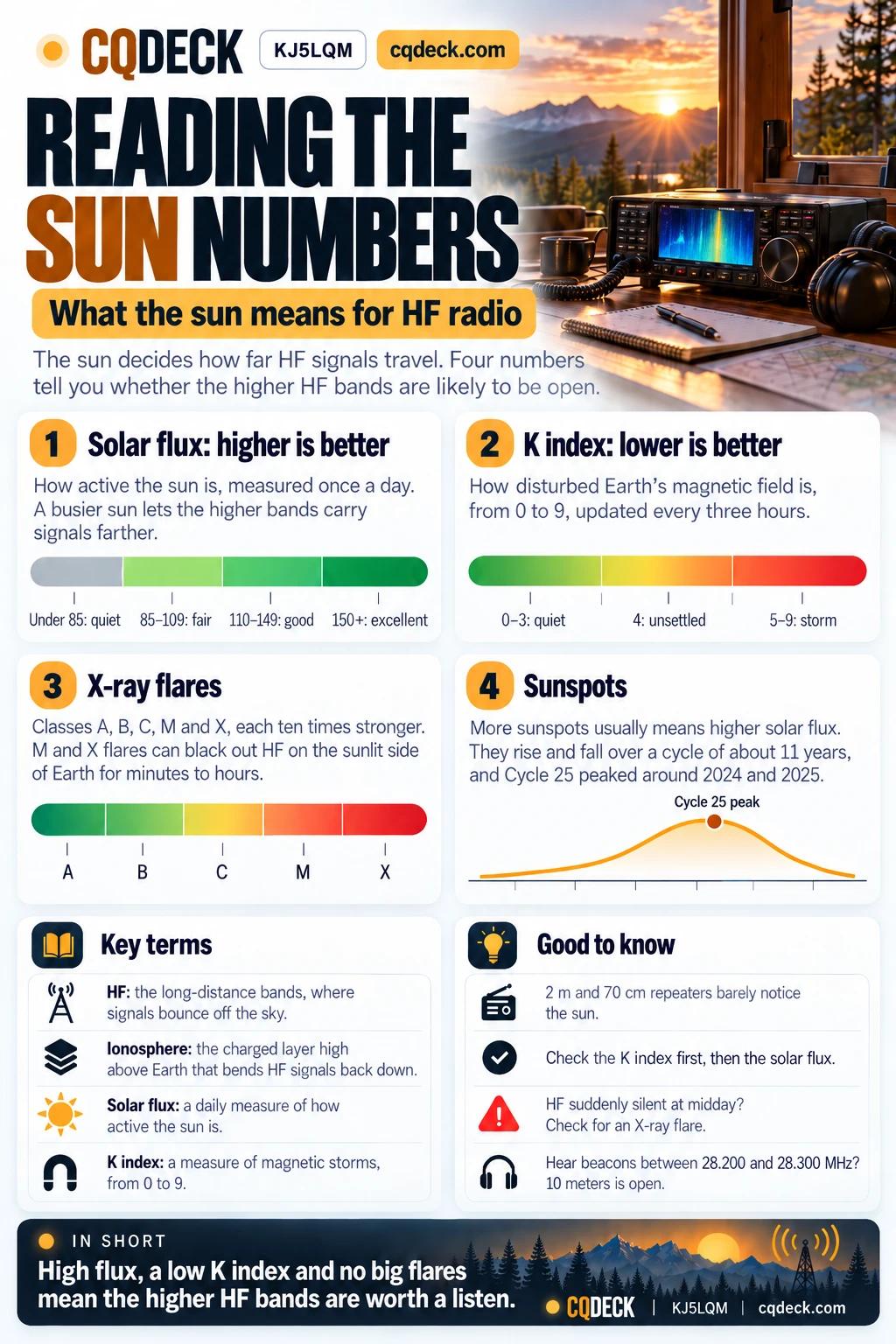
The sun decides how far signals travel. The numbers on Today’s “Sun and space” card tell you whether the higher HF bands are likely to be open, and whether a solar storm is getting in the way.
Printed from www.cqdeck.com/learn/reading-solar-numbers. The page always has the latest version.
Do you need these numbers?
- If you mostly use 2 meter and 70 centimeter repeaters, not really. signals travel by line of sight and barely notice the sun.
- They matter on HF, where signals bounce off the ionosphere to reach other states and countries. As a Technician, that means voice on 10 meters (28.300 to 28.500 MHz), on parts of 80, 40, 15 and 10 meters, and like on 10 meters.
- 10 meters swings the most with the sun: dead some days, wide open to other continents on others.
Solar flux
tracks how active the sun is. It’s reported once a day, measured at a wavelength of 10.7 centimeters, by an observatory in Canada. A more active sun charges up the ionosphere, so it can bend higher frequencies back to Earth. Higher is better.
| Solar flux | What it means |
|---|---|
| Under 85 | Quiet sun. 40 and 20 meters work; 10 meters is usually closed. |
| 85 to 109 | Moderate. 20 meters is good in daylight, and 15 meters opens some days. |
| 110 to 149 | Active. 15 meters is good, and 10 meters opens in daylight. |
| 150 and up | Very active. 10 meters can be wide open to other continents. |
These are the rules of thumb behind Today’s band estimates. Real conditions also depend on the time of day, the season and where you’re trying to reach.
The K index
The measures how disturbed Earth’s magnetic field is, from 0 to 9, and updates every three hours. Unlike flux, lower is better.
| K index | What it means |
|---|---|
| 0 to 3 | Quiet. Good for HF. |
| 4 | Unsettled. The low bands can get noisy at night, and signals may flutter. |
| 5 to 9 | Geomagnetic storm (NOAA’s G1 to G5). HF signals fade, especially toward the poles. It can also bring the northern lights farther south. |
A storm usually passes in a day or two. If HF sounds dead and the K index is high, try again tomorrow, or stick to local VHF and UHF.
X-ray flares
Solar flares are rated by their strength in classes A, B, C, M and X, each ten times stronger than the one before.
- A, B and C are background levels and small flares. They won’t affect you.
- An M or X flare can black out HF on the sunlit side of Earth within minutes, starting with the lower bands. It lasts from minutes to a few hours. NOAA rates these blackouts R1 to R5.
- The night side of Earth isn’t affected, because it faces away from the flare.
- If HF suddenly goes silent in the middle of the day, check the X-ray reading before you blame your radio.
Sunspots and the solar cycle
- are dark, magnetically active regions on the sun. More sunspots usually means higher solar flux and better HF.
- Sunspots rise and fall over a cycle of about 11 years. The current one, Solar Cycle 25, peaked around 2024 and 2025.
- Conditions will slowly ease toward the next low point, expected around 2030, but good HF days will stay common for several more years.
Other numbers you may see
- A index: a daily average of magnetic activity. Under 8 is quiet; 30 or more means a storm.
- Solar wind: the stream of particles from the sun. At speeds much above 500 km/s, it can push the K index up.
- Bz: the direction of the magnetic field carried by the solar wind. When it points strongly south (a negative number), storms can build.
- MUF: the maximum usable frequency, the highest frequency that bounces back on a given path. When it’s above 28 MHz, 10 meters is open on that path.
Put it to use
- Open Today and find the “Sun and space” card.
- Check the K index first. At 5 or more, expect weak HF signals whatever the flux says.
- Then check solar flux. Above about 110, listen on 10 meters around midday.
- “Bands for your license” turns these numbers into a quick day and night estimate for each band.
- Then listen. A real signal beats any prediction. Beacons between 28.200 and 28.300 MHz send their call signs nonstop, so if you hear them, 10 meters is open.