Free to print, share in a club newsletter or post in a group. Please keep it as is, with the CQDeck name on it.
Read it as text
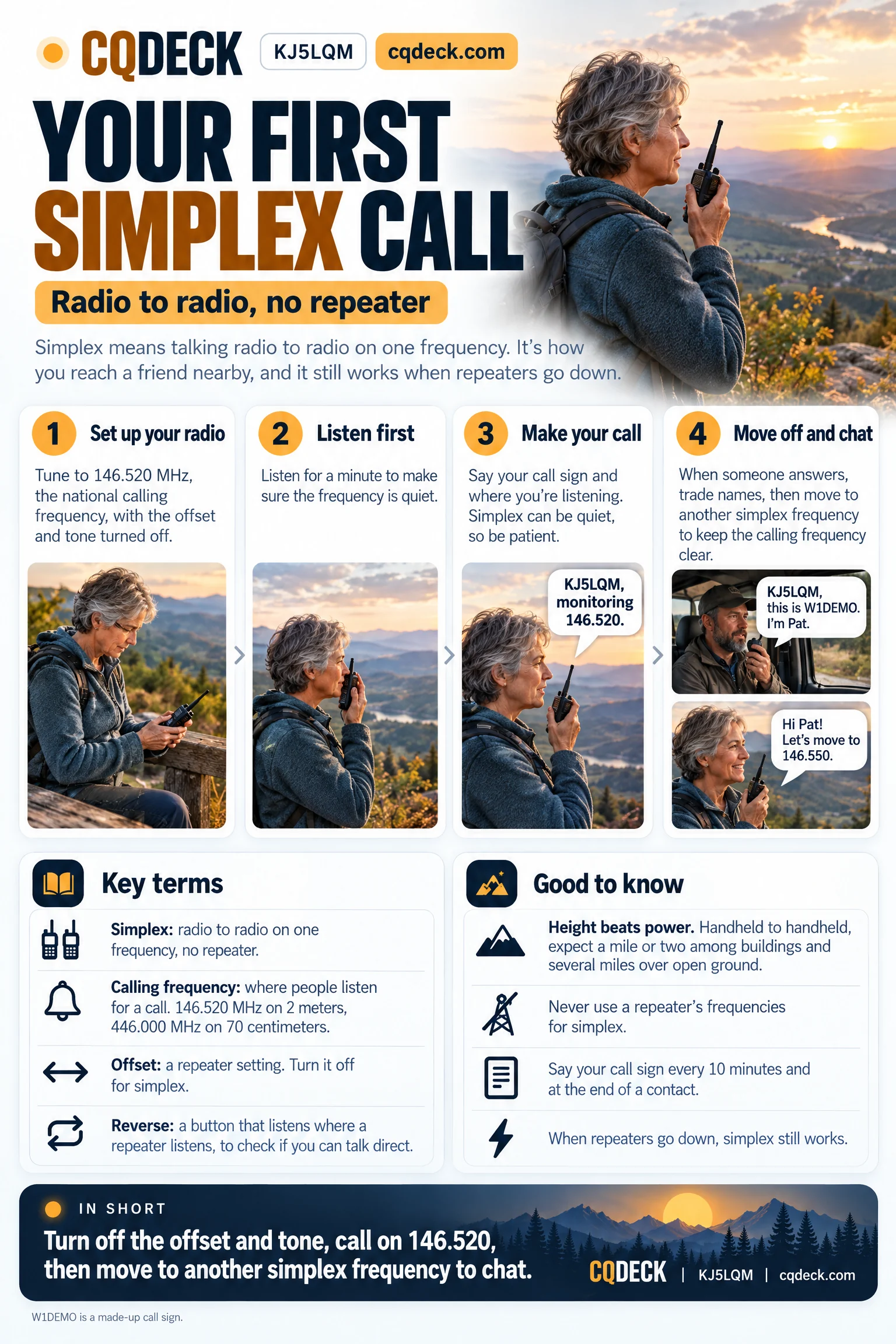
Radio to radio, no repeater. Simplex means talking radio to radio on one frequency. It’s how you reach a friend nearby, and it still works when repeaters go down.
- Set up your radio. Tune to 146.520 MHz, the national calling frequency, with the offset and tone turned off.
- Listen first. Listen for a minute to make sure the frequency is quiet.
- Make your call. Say your call sign and where you’re listening. Simplex can be quiet, so be patient.
- Move off and chat. When someone answers, trade names, then move to another simplex frequency to keep the calling frequency clear.
In the pictures
- The call: “KJ5LQM, monitoring 146.520.”
- An answer: “KJ5LQM, this is W1DEMO. I’m Pat.”
- Moving off: “Hi Pat! Let’s move to 146.550.”
Key terms
- Simplex: radio to radio on one frequency, no repeater.
- Calling frequency: where people listen for a call. 146.520 MHz on 2 meters, 446.000 MHz on 70 centimeters.
- Offset: a repeater setting. Turn it off for simplex.
- Reverse: a button that listens where a repeater listens, to check if you can talk direct.
Good to know
- Height beats power. Handheld to handheld, expect a mile or two among buildings and several miles over open ground.
- Never use a repeater’s frequencies for simplex.
- Say your call sign every 10 minutes and at the end of a contact.
- When repeaters go down, simplex still works.
In short: Turn off the offset and tone, call on 146.520, then move to another simplex frequency to chat.
W1DEMO is a made-up call sign.
Checked October 2026 against FCC Part 97 and the ARRL band plan.