Starter guide
Simplex and 146.520: frequencies and how to call
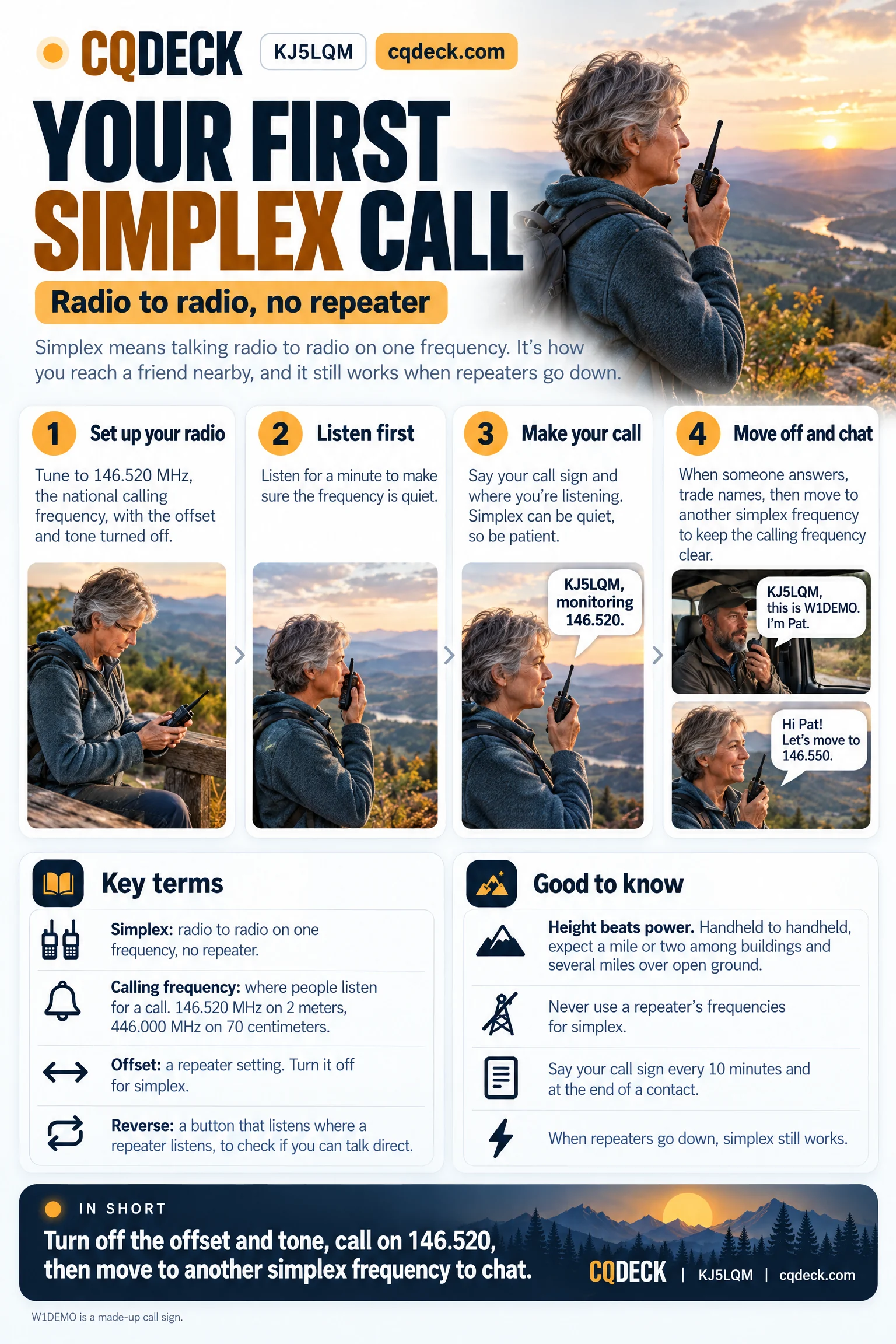
means talking radio to radio on one frequency, with no in between. It’s how you reach a friend nearby, and it still works when a repeater goes down.
Printed from www.cqdeck.com/learn/simplex. The page always has the latest version.
The short version
- Start on
146.520MHz, the national 2 meter calling frequency, and move to another simplex frequency once you’ve made contact. - Handheld to handheld, expect a mile or two among buildings and several miles over open ground. Height helps more than power.
- It keeps working when repeaters go down, which is why emergency plans count on it.
How it works
- You transmit and listen on the same frequency, so turn the and off.
- Height and antennas matter more than power. Handheld to handheld, expect a mile or two among buildings and several miles over open ground. Hilltops, rooftops and car antennas stretch that a lot.
- The same rules apply as on a repeater: give your call sign at the end of each contact and at least every 10 minutes.
Simplex or repeater?
| Simplex | Repeater | |
|---|---|---|
| The path | Straight from your radio to theirs | Up to a repeater on a hill or tower, then back down |
| Frequencies | One: you talk and listen on the same frequency | Two: the repeater listens on one and transmits on the other |
| Radio settings | Offset and tone off | The repeater’s offset, and often a tone |
| Range from a handheld | A mile or two among buildings, several miles over open ground | As far as the repeater reaches, which can be 30 miles or more |
| In a power outage | Works as long as your radios have power | Works only if the repeater has backup power |
The calling frequencies
Each band has a national calling frequency, where people listen for a call.
| Band | Frequency | Notes |
|---|---|---|
| 2 meters | 146.520 MHz | The busiest. Every 2 meter radio covers it. |
| 70 centimeters | 446.000 MHz | Quieter, but worth saving. |
| 1.25 meters | 223.500 MHz | Needs a radio with the 222 MHz band. |
| 6 meters | 52.525 MHz | Needs a radio with the 6 meter band. |
Calling frequencies are for making contact. Once you’ve reached someone, move to another simplex frequency so the channel stays open for others.
Other simplex frequencies
- In most of the US, 146.400 to 146.580 MHz and 147.420 to 147.570 MHz are set aside for 2 meter simplex.
146.550is a popular choice. - Band plans vary by region, and some areas use parts of those ranges for repeaters. Check your area’s band plan or ask your club before you settle on a frequency.
- Never use a repeater’s input or output frequency for simplex. You’d interfere with everyone on the repeater.
- Stay off 145.800 to 146.000 MHz. The band plan saves it for satellites.
How to make a call
- Listen for a minute to make sure the frequency is quiet.
- Say your and where you’re listening: “N0CALL, monitoring 146.520.” Calling is fine on simplex too.
- Wait a minute or so, then try again. Simplex can be quiet, so be patient.
- When someone answers, trade names and locations, then suggest moving off the calling frequency: “Let’s move to 146.550.”
- On the new frequency, call the other station to confirm you both made it.
An example contact
- YouN0CALL, monitoring 146.520.
- W1DEMON0CALL, this is W1DEMO. You’re a little scratchy but readable. I’m Pat, about six miles north of town.
- YouW1DEMO, thanks, Pat. I’m Sam, on a handheld in my back yard. Want to move to 146.550 and free up the calling frequency?
- W1DEMOSounds good. Meet you on 146.550. W1DEMO.
- YouN0CALL, moving to 146.550.
Try reverse on a repeater
Many radios have a reverse setting that swaps a repeater’s two frequencies, so you listen where the repeater listens.
- If you can hear the other station directly with reverse on, you’re close enough to talk on simplex.
- Moving a long conversation to simplex frees the repeater for everyone else.
When the repeaters go down
- In storms and power outages, repeaters can fail. Simplex is what’s left, and many emergency plans rely on it.
- Practice with a friend so you know your range before you need it. Try from home, from high ground and from your car.
- Some clubs hold simplex nights or contests. They’re a fun way to find out how far your station reaches.