Starter guide
DMR basics: talkgroups, networks and hotspots
is a digital voice mode whose repeaters and hotspots are often linked over the internet, so a Technician with a handheld can talk across the state or around the world. It takes more setup than FM and comes with new words. Here’s what they mean, in the order you’ll meet them.
Printed from www.cqdeck.com/learn/dmr-basics. The page always has the latest version.
The short version
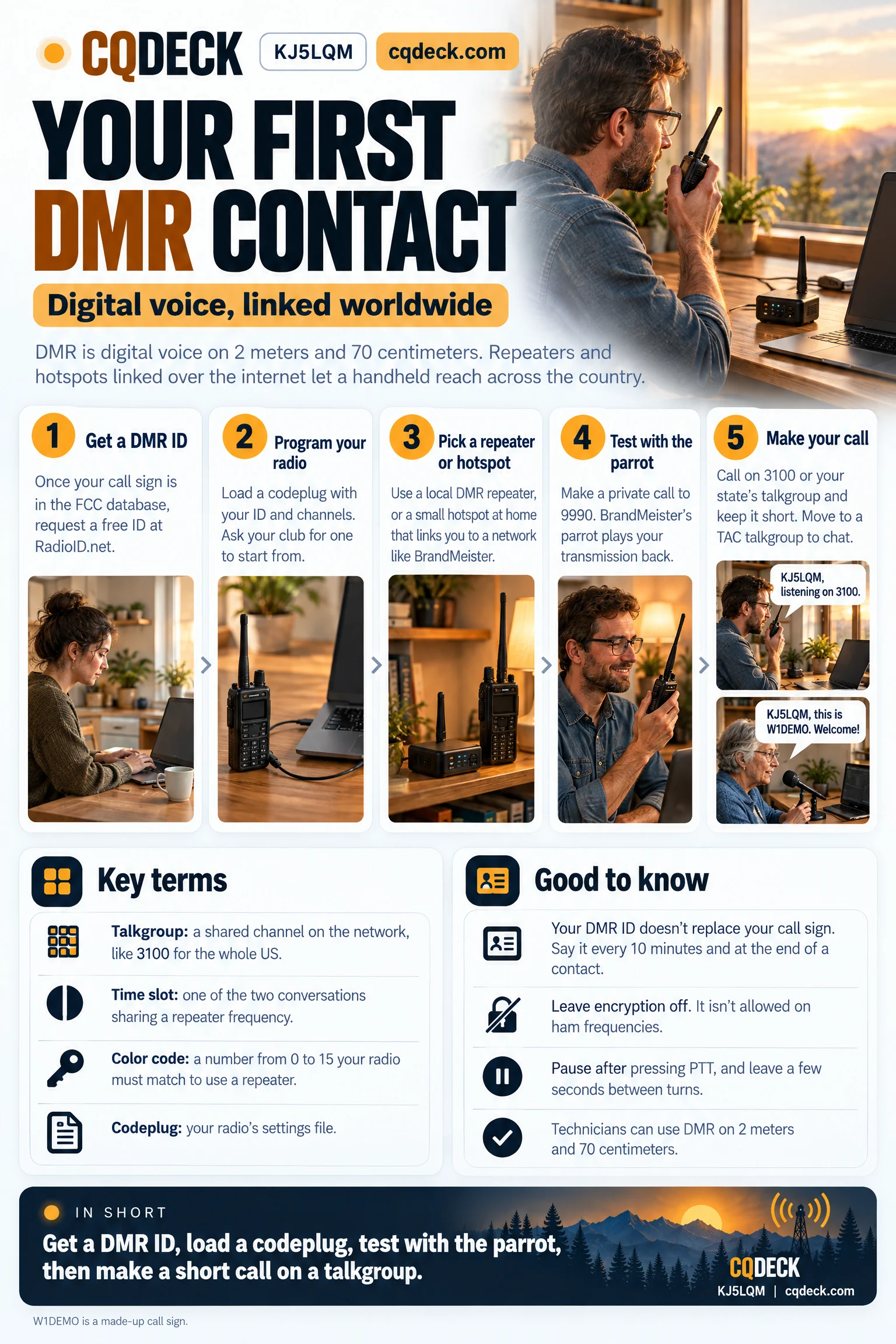
- DMR is digital voice on 2 meters and 70 centimeters, so Technicians can use it.
- You need a DMR radio, a free DMR ID from RadioID.net, and a DMR repeater or a at home.
- Networks like BrandMeister link repeaters and hotspots over the internet, and sort the traffic. On BrandMeister, 3100 reaches the whole US.
- Your DMR ID doesn’t replace your call sign. Say it at the end of each contact and at least every 10 minutes.
What DMR is
DMR, short for Digital Mobile Radio, started as a business radio standard. Hams use it on 2 meters and 70 centimeters, often through repeaters linked to a worldwide network.
- Your voice travels as digital data. It stays clear until the signal gets too weak, then drops out instead of getting noisy like FM.
- Each repeater frequency carries two conversations at once, one on each .
- Networks like BrandMeister link thousands of repeaters and personal hotspots, and sort the traffic into .
- Most DMR handhelds also do regular FM, so one radio covers both.
- You need
- A DMR radio (roughly $60 to $250 for a dual-band handheld), a DMR ID, and a DMR repeater or .
- Technicians
- Yes. DMR repeaters and hotspots are on 2 meters and 70 centimeters.
Get your DMR ID
Every DMR radio sends a seven-digit ID with each transmission. It’s how the network and other radios know who’s talking. RadioID.net issues them for free.
- Wait until your call sign shows up in the FCC database.
- In the FCC’s License Manager, choose Download Electronic Authorizations and save the official PDF of your license. RadioID doesn’t accept screenshots or reference copies.
- Create an account at RadioID.net, request a DMR ID and upload the PDF.
- Once it’s approved, enter the ID in your radio’s settings.
Your DMR ID doesn’t count as station identification. Say your at the end of each contact and at least every 10 minutes, just as on FM.
Try itRadioID.net
Talkgroups, time slots and color codes
These three settings decide who hears you. Each repeater lists its own, on its website or on the network’s dashboard.
| Setting | What it is | Closest thing on FM |
|---|---|---|
| Color code | A number from 0 to 15 your radio must match to use a repeater | A repeater’s tone |
| Time slot | Slot 1 or 2: the two conversations sharing a repeater frequency | Two channels on one frequency |
| Talkgroup | A shared channel on the network, such as 3100 for the whole US or your state’s four-digit talkgroup | A linked repeater system |
- A static talkgroup is always on a repeater. A dynamic one turns on when you key up on it, and on BrandMeister’s US servers it turns off after 15 minutes without local traffic.
- The repeater owner decides which talkgroups use which time slot. Check the repeater’s page, and ask which slot to use for dynamic talkgroups. It’s usually slot 1.
- You talk to a talkgroup with a group call. A private call goes to a single ID, like the network’s test service.
DMR networks: BrandMeister, TGIF and others
A DMR network is a set of internet servers that links repeaters and hotspots. A call on a talkgroup goes out on every repeater and hotspot that has that talkgroup on. Each repeater joins one network, chosen by its owner.
- BrandMeister is the biggest network and the usual place to start. Its main talkgroup for the US is 3100.
- TGIF and FreeDMR are other volunteer-run networks. You reach them through a hotspot, or a repeater that joins them.
- Talkgroup numbers belong to each network, and the networks mostly don’t link to each other. BrandMeister isn’t adding new bridges to networks like FreeDMR. Check which network a repeater uses before you program its talkgroups.
- Your DMR ID works on every network. A hotspot connects to the network you pick in its settings.
- DMR also works radio to radio, with no network at all. A common choice for DMR simplex is
441.000MHz with color code 1, time slot 1 and talkgroup 99. Check your area’s band plan first, since some areas use that part of 70 centimeters for repeaters.
Try itBrandMeisterTGIF Network
Program the radio: the codeplug
A DMR radio’s settings file is its . It holds your ID, your channels and your talkgroups, and it takes longer to build than an FM channel list.
- A channel pairs a frequency, color code and time slot with the talkgroup you’ll talk on. Its receive group list sets which other talkgroups it lets you hear.
- Zones are folders of channels, such as one zone per repeater.
- Contacts are the talkgroups and IDs you can call. Many radios can also load RadioID’s user list, so the screen shows the call sign and name of whoever is talking.
- CHIRP doesn’t program DMR radios. Use the maker’s programming software, often called CPS.
- Ask your local club or repeater owner for a codeplug to start from. Many share one, and it saves hours.
- Leave encryption, sometimes called privacy, turned off. It isn’t allowed on ham frequencies.
No DMR repeater nearby? Use a hotspot
A hotspot is a tiny, low-power station in your home that links your radio to the network over the internet. It covers a room or a yard, not the neighborhood.
- Many run free software like Pi-Star on a Raspberry Pi with a small radio board. Ready-made ones like the openSPOT need less setup.
- It’s still an amateur station. Set it to a 70 centimeter simplex frequency your local band plan allows, and stay out of 435 to 438 MHz, which is for satellites.
- Most hotspots work on one time slot. On BrandMeister, the talkgroup you last keyed up on stays on until you pick another.
- BrandMeister asks you to set a hotspot password in its SelfCare dashboard, then enter the same password in your hotspot.
- You need
- A hotspot, home internet, a free BrandMeister account and your DMR ID.
- Technicians
- Yes. Most hotspots run on 70 centimeters.
Your first DMR contact
- Listen first. BrandMeister’s Hose plays any talkgroup in your browser, and on the air your radio shows who’s talking.
- Test your setup with a private call to 9990, BrandMeister’s parrot. It plays your transmission back to you.
- Pause a moment after pressing the button before you speak, and leave 2 to 5 seconds between transmissions so others can join in.
- Make a short call on your state’s talkgroup or 3100. Statewide talkgroups are for calls and short chats, under about 10 minutes.
- If the chat will run long, move to a TAC talkgroup (310 to 319) or a local one. They exist so busy talkgroups stay free.
An example contact
A short first contact on the US nationwide talkgroup, ending with a move to a TAC talkgroup.
- YouN0CALL, listening on 3100.
- W1DEMON0CALL, this is W1DEMO. Welcome! I’m Pat, near Riverton.
- YouW1DEMO, thanks, Pat. I’m Sam, on a handheld through my hotspot. It’s my first DMR contact. How’s my audio?
- W1DEMOClear and easy to understand, Sam. Congratulations! Let’s move to TAC 310 so we don’t tie up 3100.
- YouSounds good. See you on 310. N0CALL.
DMR, D-STAR and System Fusion
Hams use three main digital voice systems. They can’t talk to each other directly, so start with the one your local repeaters use.
| DMR | D-STAR | System Fusion | |
|---|---|---|---|
| Radios | Many brands, often the least expensive | Mostly Icom | Yaesu |
| How you connect | Talkgroups on networks like BrandMeister | Reflectors | WIRES-X rooms and reflectors |
| Setup | A codeplug and a DMR ID | Your call sign in the radio | Your call sign in the radio |
Sources
- BrandMeister USA: dynamic and static talkgroups
- BrandMeister USA: operating etiquette
- BrandMeister USA: statewide talkgroups
- BrandMeister USA: TAC channels
- BrandMeister USA: talkgroup 3100
- BrandMeister USA: bridging to other networks
- BrandMeister USA: hotspot questions
- BrandMeister wiki: Parrot
- ARRL band plan
- FCC rule 97.113: prohibited transmissions
- FCC rule 97.119: station identification