Starter guide
Repeater etiquette for new hams
Everyone in range shares a , like one big conference call. A few habits will make you sound like you’ve been doing this for years, and most of them come down to listening first and keeping it short.
Printed from www.cqdeck.com/learn/repeater-etiquette. The page always has the latest version.
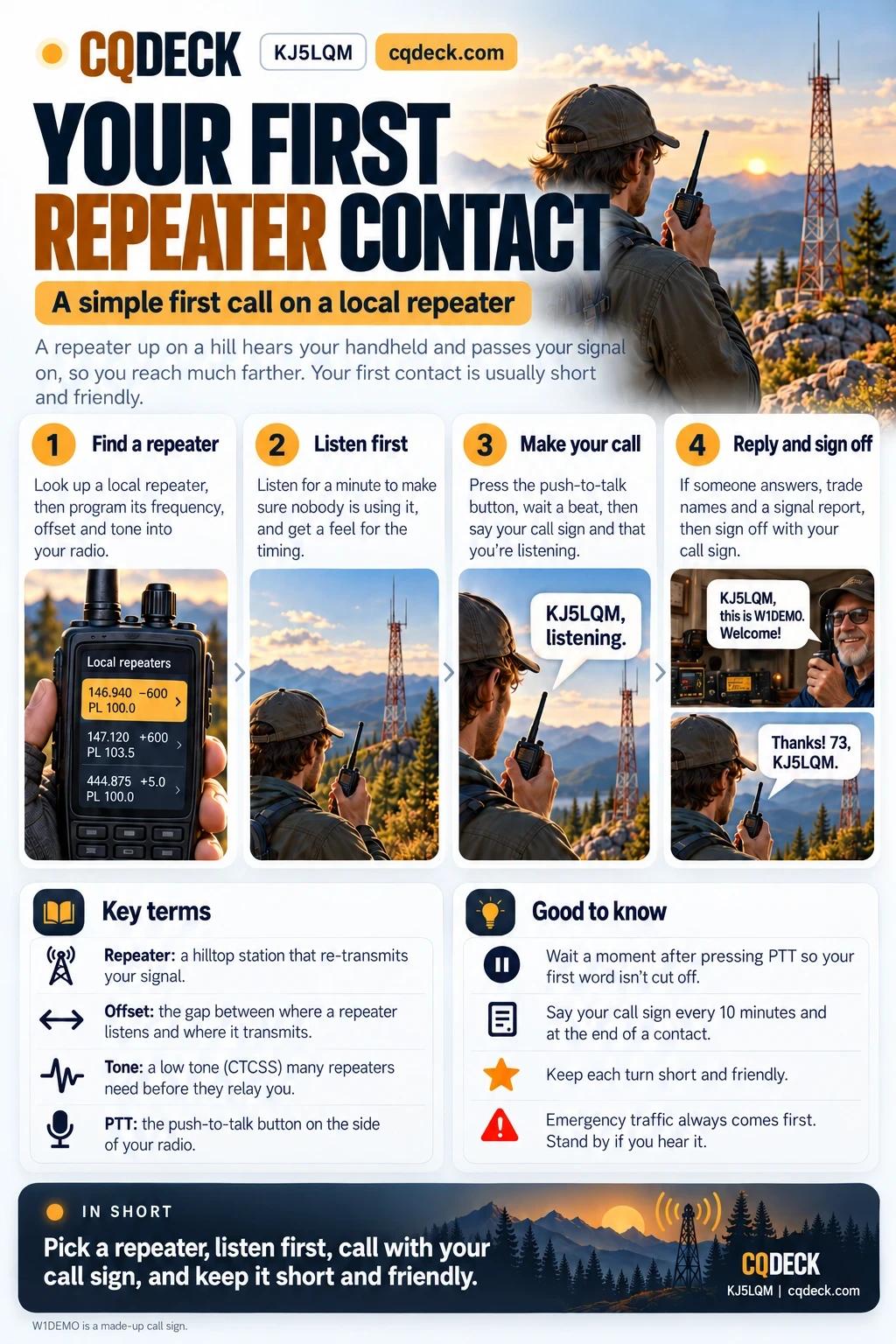
Listen first
- Before you press the push-to-talk button, listen for a minute. A quiet repeater may be in the middle of a conversation, with people pausing between turns.
- Spend an evening or two just listening to your local repeaters. You’ll pick up how people there call, chat and sign off. Every repeater has its own personality.
Make a call
On FM repeaters, people don’t usually call . They say their and that they’re listening.
- To see who’s around, say your call sign and “listening” or “monitoring”: “N0CALL, listening.”
- To reach someone specific, say their call sign, then yours: “W1DEMO, this is N0CALL.”
- If nobody answers, that’s normal. Try again later; evenings and weekends are busiest.
- Keying up just to hear the repeater answer, without saying your call sign, is called kerchunking. Skip it. To test, say your call sign and “testing.”
Take turns
- Press the button, wait a moment, then speak. Talk the instant you press it and your first word can get cut off.
- When the other station lets go, wait for the courtesy beep, or a second or two, before you answer. That gap lets others break in and resets the repeater’s timer.
- Keep each turn short. Most repeaters cut you off after a few minutes of talking without a break.
- You don’t need to say “over.” On a repeater, the beep and the pause do that job.
Give your call sign
- The FCC requires your call sign at the end of each contact and at least every 10 minutes during one. Most hams say it at the start too.
- In a quick back-and-forth, you don’t need it every turn. Just keep an eye on the clock.
- Use when someone asks you to repeat your call sign, or when you’re new on a repeater and people don’t know you yet.
- Sign off with your call sign: “Thanks for the chat, from N0CALL,” or just “N0CALL, clear.”
Join in or break in
- To join a conversation, say your call sign during a pause between turns. The stations will invite you in when they can.
- Save the word “break” for something urgent. On most repeaters, “break” means someone needs the frequency now, and everyone stops to listen.
- In a real emergency, say “emergency” with your call sign. Emergency traffic always comes first. If you hear it, stay off the air unless you can help.
What the FCC doesn’t allow
These are rules, not just manners, and they apply on every ham frequency.
- No profanity or indecent language, and no music.
- No codes or ciphers meant to hide what you’re saying.
- No business: you can’t use ham radio for your job or to earn money.
- No broadcasting to the general public, and no false or deceptive signals.
- No deliberate interference with other stations.
Be a good neighbor
Anyone can listen to a repeater, including kids and people with scanners. Talk like you would in a room full of strangers.
- Use everyday language. CB phrases like “10-4” and “what’s your 20” aren’t used on ham repeaters; say “roger” and “where are you?”
- Many repeaters discourage politics and religion, because they tend to start arguments.
- Long chats are welcome, but if others are waiting, move to a frequency to free up the repeater.
- Most repeaters are built and paid for by local clubs. Joining the club behind your favorite one helps keep it on the air.
An example contact
A typical first contact on a local repeater. Notice how short each turn is.
- YouN0CALL, listening.
- W1DEMON0CALL, this is W1DEMO. Good evening! I’m Pat, over in Riverton. I don’t think I’ve heard you before. Welcome to the repeater.
- YouW1DEMO, thanks, Pat. I’m Sam, licensed this month, on a handheld from my back porch. How am I sounding?
- W1DEMOFull quieting, Sam. Clear as a bell. Congratulations on the license! The club runs a net here Tuesday nights at 8 if you’d like to check in.
- YouI’ll listen for it. Thanks for the welcome, Pat. 73, N0CALL.
- W1DEMO73, Sam. W1DEMO.
“Full quieting” means your signal is strong enough that there’s no background hiss. It’s the best you can get on FM.