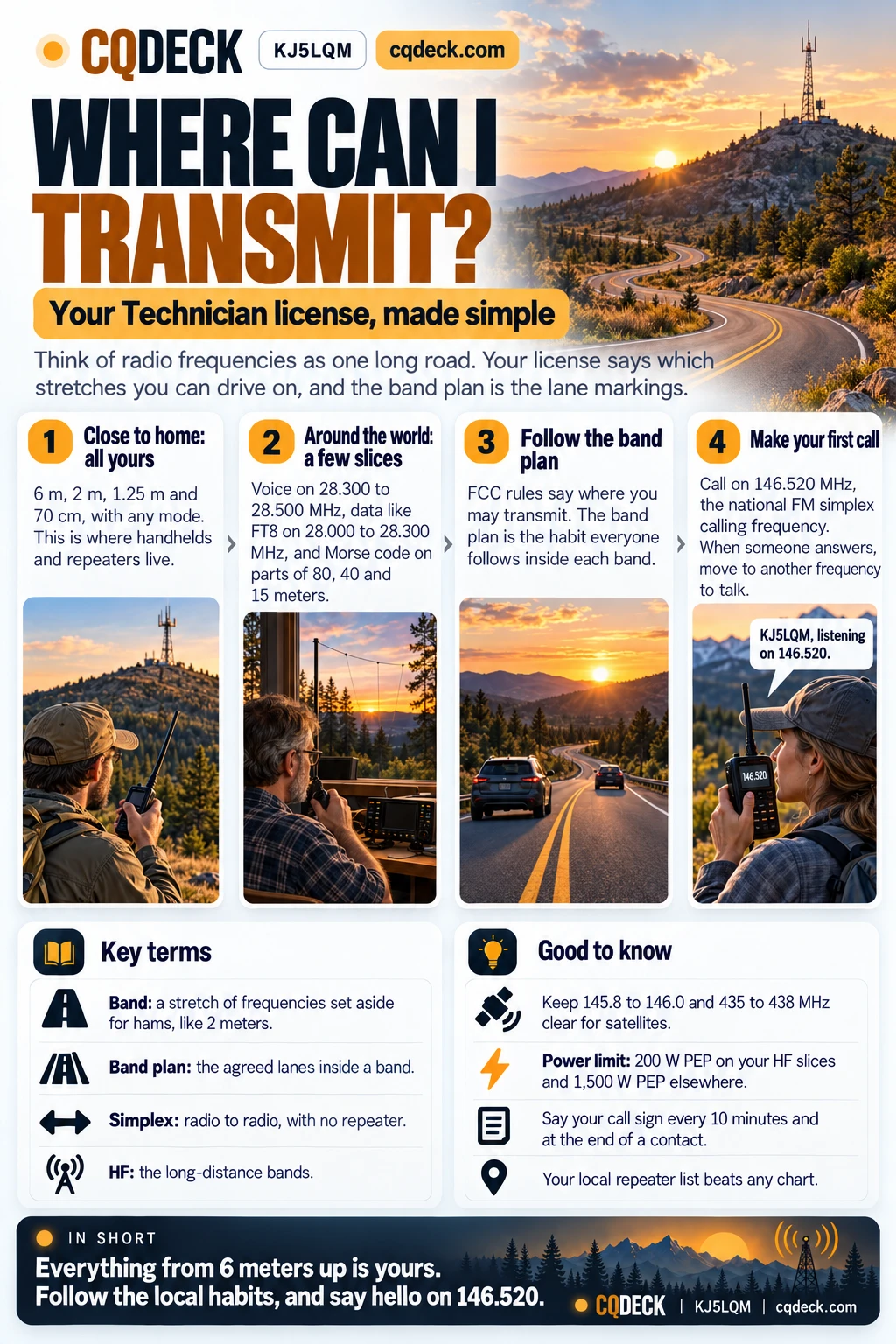
Free to print, share in a club newsletter or post in a group. Please keep it as is, with the CQDeck name on it.
Read it as text
Your Technician license, made simple. Think of radio frequencies as one long road. Your license says which stretches you can drive on, and the band plan is the lane markings.
- Close to home: all yours. 6 m, 2 m, 1.25 m and 70 cm, with any mode. This is where handhelds and repeaters live.
- Around the world: a few slices. Voice on 28.300 to 28.500 MHz, data like FT8 on 28.000 to 28.300 MHz, and Morse code on parts of 80, 40 and 15 meters.
- Follow the band plan. FCC rules say where you may transmit. The band plan is the habit everyone follows inside each band.
- Make your first call. Call on 146.520 MHz, the national FM simplex calling frequency. When someone answers, move to another frequency to talk.
In the pictures
- A first call on a handheld tuned to 146.520: “KJ5LQM, listening on 146.520.”
Key terms
- Band: a stretch of frequencies set aside for hams, like 2 meters.
- Band plan: the agreed lanes inside a band.
- Simplex: radio to radio, with no repeater.
- HF: the long-distance bands.
Good to know
- Keep 145.8 to 146.0 and 435 to 438 MHz clear for satellites.
- Power limit: 200 W PEP on your HF slices and 1,500 W PEP elsewhere.
- Say your call sign every 10 minutes and at the end of a contact.
- Your local repeater list beats any chart.
In short: Everything from 6 meters up is yours. Follow the local habits, and say hello on 146.520.
Checked October 2026 against FCC Part 97 and the ARRL band plan.