Free to print, share in a club newsletter or post in a group. Please keep it as is, with the CQDeck name on it.
Read it as text
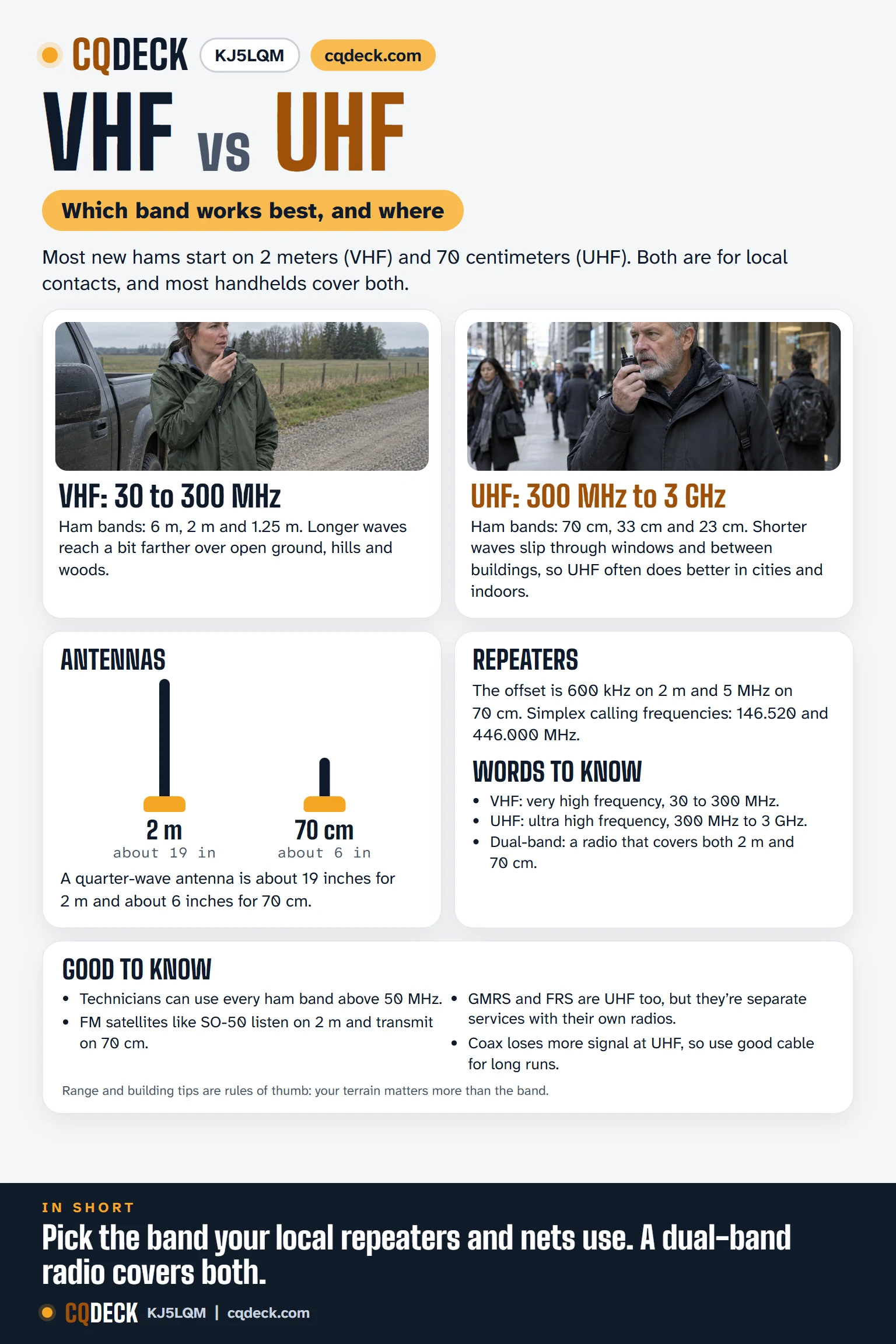
Which band works best, and where. Most new hams start on 2 meters (VHF) and 70 centimeters (UHF). Both are for local contacts, and most handhelds cover both.
- VHF: 30 to 300 MHz. Ham bands: 6 m, 2 m and 1.25 m. Longer waves reach a bit farther over open ground, hills and woods.
- UHF: 300 MHz to 3 GHz. Ham bands: 70 cm, 33 cm and 23 cm. Shorter waves slip through windows and between buildings, so UHF often does better in cities and indoors.
- Antennas. A quarter-wave antenna is about 19 inches for 2 m and about 6 inches for 70 cm.
- Repeaters. The offset is 600 kHz on 2 m and 5 MHz on 70 cm. Simplex calling frequencies: 146.520 and 446.000 MHz.
Key terms
- VHF: very high frequency, 30 to 300 MHz.
- UHF: ultra high frequency, 300 MHz to 3 GHz.
- Dual-band: a radio that covers both 2 m and 70 cm.
Good to know
- Technicians can use every ham band above 50 MHz.
- FM satellites like SO-50 listen on 2 m and transmit on 70 cm.
- GMRS and FRS are UHF too, but they’re separate services with their own radios.
- Coax loses more signal at UHF, so use good cable for long runs.
In short: Pick the band your local repeaters and nets use. A dual-band radio covers both.
Range and building tips are rules of thumb: your terrain matters more than the band.
Checked October 2026 against FCC Part 97, the ARRL band plan and AMSAT's FM satellite list.