Starter guide
VHF vs UHF: what’s the difference?
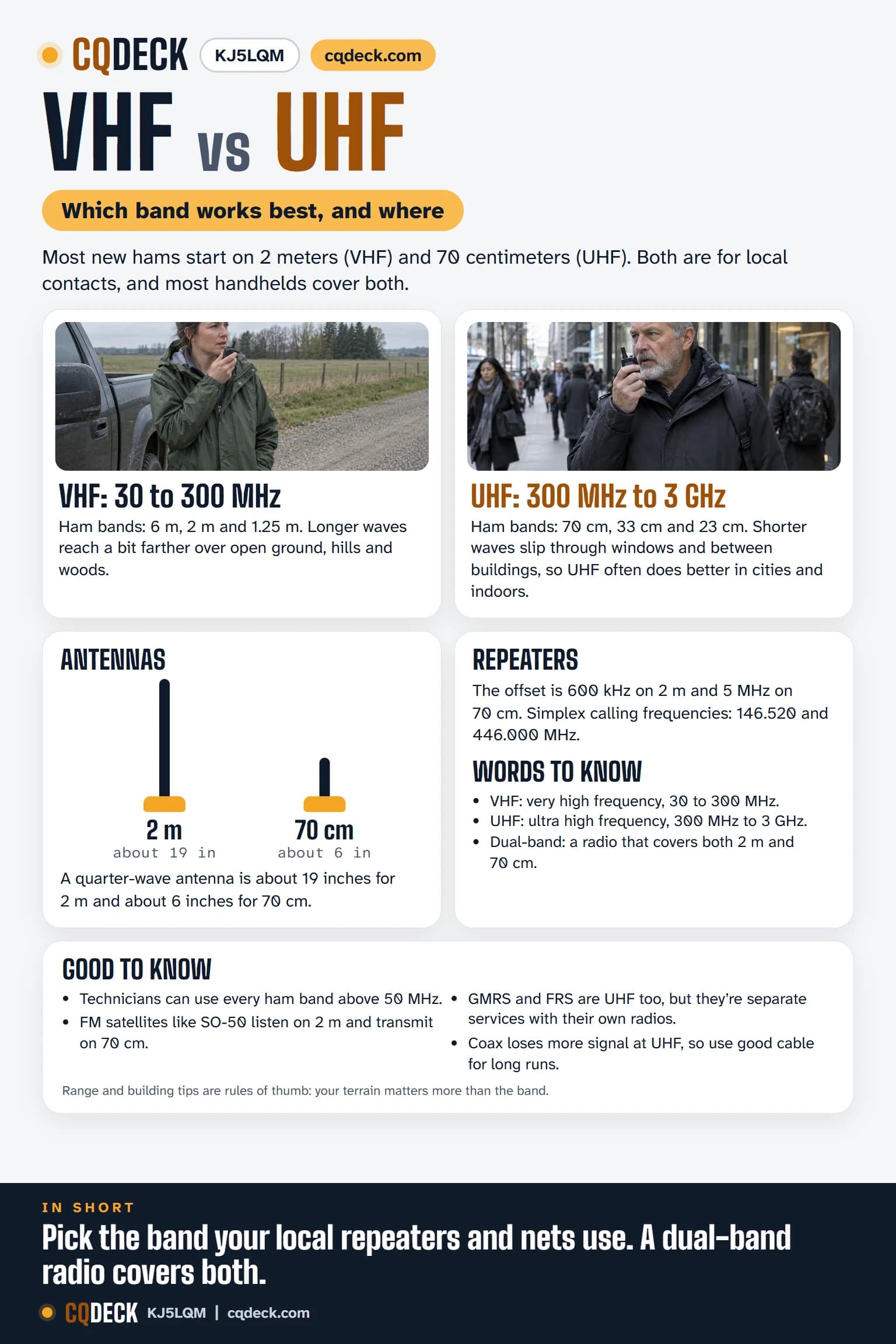
Most new hams start on two bands: 2 meters, which is , and 70 centimeters, which is UHF. Both are for local contacts, and most handhelds cover both. The differences are in where each one works best.
Printed from www.cqdeck.com/learn/vhf-vs-uhf. The page always has the latest version.
The short version
- VHF runs from 30 to 300 MHz and UHF from 300 MHz to 3 GHz. Both travel mostly in straight lines, so they’re for local contacts and .
- As a rule of thumb, VHF reaches a little farther over open ground and through trees, and UHF does better in cities and inside buildings.
- Technicians have full privileges on every ham band above 50 MHz, so you can use both.
- Pick the band your local repeaters and nets use. A dual-band radio covers both.
The ham bands on each side
Hams name bands by their wavelength. Six of them sit in the VHF and UHF range.
| Band | Frequencies | Side | What it’s used for |
|---|---|---|---|
| 6 m | 50–54 MHz | VHF | Called the magic band: mostly local, with occasional openings across the country |
| 2 m | 144–148 MHz | VHF | FM repeaters, simplex, nets and satellites |
| 1.25 m | 222–225 MHz | VHF | Fewer radios and repeaters, so it’s often quiet |
| 70 cm | 420–450 MHz | UHF | FM repeaters, simplex, satellites and DMR |
| 33 cm | 902–928 MHz | UHF | Shared with other devices; some repeaters, and Meshtastic in licensed mode |
| 23 cm | 1240–1300 MHz | UHF | Specialized radios, experiments and some repeaters |
- Technicians
- Full privileges, all modes, on every band in this table.
Which goes farther, and where
- Both travel mostly in straight lines, so height matters more than power. A handheld on a hilltop beats a powerful radio in a valley.
- VHF waves are longer. Over open ground, hills and woodland they bend a little more around obstacles and lose less in trees, so 2 meters often reaches a bit farther.
- UHF waves are shorter. They slip through windows and gaps between buildings more easily, so 70 centimeters often does better in cities and indoors.
- These are rules of thumb. Your local terrain and the repeaters around you matter more than the band.
Antennas
- Antennas scale with wavelength. A quarter-wave antenna is about 19 inches long for 2 meters and about 6 inches for 70 centimeters.
- The antenna on most handhelds is built to work on both bands.
- Coax cable loses more signal at UHF than at VHF, so a long cable run hurts 70 centimeters more. Use good, low-loss coax for long runs.
- A better antenna often helps more than more power. A longer antenna on a handheld is a cheap upgrade.
Repeaters and calling frequencies
A repeater listens on one frequency and transmits on another. The gap is the , and it differs by band. On , radio to radio, each band has a calling frequency.
| Band | Repeater offset | Simplex calling frequency |
|---|---|---|
| 2 m | 600 kHz: minus below 147 MHz, plus from 147 MHz up (most areas) | 146.520 MHz |
| 70 cm | 5 MHz, plus or minus by area | 446.000 MHz |
Most repeaters also need a CTCSS tone before they’ll relay you. Repeater listings give the output frequency, the offset and the tone.
Show the 2 m and 70 cm band plans
The ARRL’s voluntary band plans show where repeaters, simplex, satellites and weak-signal work go on each band.
2 meters: the band plan
| MHz | Used for |
|---|---|
| 144.000–144.100 | CW only (an FCC rule) |
| 144.100–144.275 | SSB and weak signals |
| 144.275–144.300 | Propagation beacons |
| 144.300–144.500 | Satellites |
| 144.500–144.600 | Linear translator inputs |
| 144.600–144.900 | Repeater inputs |
| 144.900–145.100 | Weak signal and FM simplex |
| 145.100–145.200 | Linear translator outputs |
| 145.200–145.500 | Repeater outputs |
| 145.500–145.800 | Experimental modes |
| 145.800–146.000 | Satellites |
| 146.000–146.400 | Repeater inputs |
| 146.400–146.600 | FM simplex |
| 146.600–147.400 | Repeater outputs |
| 147.400–147.600 | FM simplex |
| 147.600–148.000 | Repeater inputs |
70 centimeters: the band plan
| MHz | Used for |
|---|---|
| 420.000–432.000 | Amateur TV and links |
| 432.000–433.000 | CW, SSB and weak signals |
| 433.000–435.000 | Links |
| 435.000–438.000 | Satellites only |
| 438.000–442.000 | Amateur TV and links |
| 442.000–445.000 | Repeaters (local option) |
| 445.000–447.000 | Simplex, links and repeaters |
| 447.000–450.000 | Repeaters (local option) |
Good to know
- Most handhelds, like the Baofeng UV-5R, are dual-band: they cover both 2 meters and 70 centimeters.
- The FM satellites use both bands. SO-50 listens on 145.850 MHz, on 2 meters, and transmits on 436.795 MHz, on 70 centimeters, so you need a dual-band radio.
- and radios are UHF too, around 462 and 467 MHz, but they’re separate services. A ham handheld can listen there but isn’t legal to transmit on them.
- NOAA Weather Radio is VHF, broadcasting between 162.400 and 162.550 MHz, and most ham handhelds can receive it.
Which should you start with?
- Look up the repeaters and nets near you. Use the band they’re on; in many areas that’s both.
- Program a few of each into a dual-band radio.
- Listen from home and from the places you go most, and keep the ones you hear well.
Mostly indoors or in town? Try 70 centimeters first. Out in the country, 2 meters often reaches farther.